The induction ceremony for newly elected Fellows of the Geological Society of America (GSA) took place on October 11 at the Colorado Convention Center in Denver, Colorado, USA. In May this year, GSA announced its 2026 Class of Fellows, among whom Professor Wang Lu from our university was successfully elected. A total of 19 new Fellows were admitted this year from five countries, including five non‑US scholars, two of whom are from China.
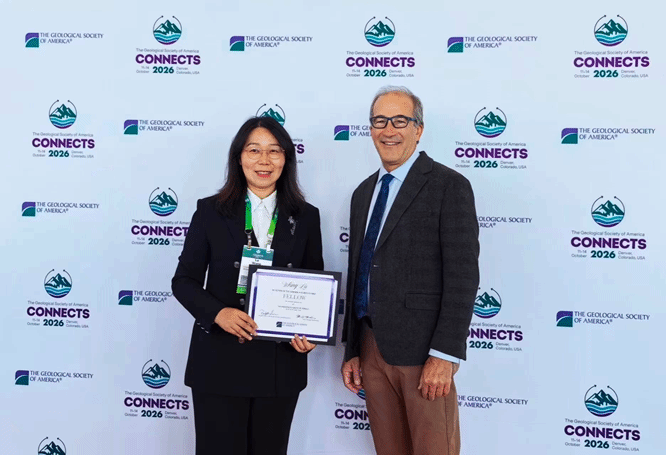
Professor Wang Lu (left) with Professor Glenn Thackray, President of GSA, at the induction ceremony for new Fellows in Denver, USA, on October 11, 2026.
Founded in 1888, the Geological Society of America is one of the world’s oldest and most influential international academic organizations in Earth sciences. GSA Fellowship (Fellow of the Geological Society of America) is conferred upon scholars with sustained and outstanding contributions to geological research and society service. Candidates are nominated jointly by current GSA Fellows, vetted through multiple rigorous review rounds, and elected at the Spring Council Meeting. It is widely recognized as a prestigious academic honor in the global geoscience community.
Professor Wang Lu is a PhD supervisor at the National Key Laboratory of Geological Processes and Mineral Resource Prediction and Deputy Director of the Global Tectonics Center at our university. She serves as Editor‑in‑Chief of the GSA Bulletin (2026–2029), one of the few Chinese scholars to hold the Editor‑in‑Chief position at a leading international geoscience journal. In this role, she brings a Chinese scholarly voice to academic guidance and standard‑setting for core international geoscience publications. She also serves as Associate Editor of Journal of Asian Earth Sciences‑X, Editorial Board Member of Lithos and Earth Science, and holds committee positions with the Petrology Commission of the Geological Society of China and the GSA International Committee.
Professor Wang Lu’s research centers on the cutting‑edge international scientific question of how plate tectonics acts as the core driver for the growth and reworking of continental crust. She has developed a systematic research framework that links modern and ancient geological records to interpret early Earth evolution, and has produced a series of original landmark results. Notably, she first identified and characterized an 1800‑km‑long linear orogenic belt in the North China Craton, providing critical geological evidence for the onset of modern‑style plate tectonics in the late Archean. This work offers key constraints from the North China Craton to address the fundamental global geoscience question of when and how plate tectonics initiated on Earth. Through large‑scale field mapping and multi‑scale laboratory analyses, she has deciphered multi‑stage, multi‑mechanism partial melting during the exhumation of deeply subducted continental crust and its impacts on exhumation dynamics, yielding vital insights into the initiation of plate tectonics and continental crustal growth. She was awarded the Evgenii Brouwer Medal by the International Lithosphere Programme (IUGS) in recognition of her outstanding scientific contributions: using field observations to reveal the effects of melting on the lithosphere and identify key evidence for Archean plate tectonic regimes.
The GSA nomination letter by Professor Meifu Zhou, GSA Fellow, SEG Fellow and researcher at the Institute of Geochemistry, Chinese Academy of Sciences, highlights Professor Wang Lu’s two major research themes. For deep processes in modern orogenic belts, the citation recognizes her exceptional contributions to understanding the exhumation dynamics of deeply subducted continental crust in collisional orogens, as well as partial melting of eclogite and how P‑T‑t‑d‑X (deformation‑fluid) reactions lubricate exhumation channels. For the tectonic evolution of the early Earth, it acknowledges her seminal work extending research into the Archean and quantifying early tectonic regimes through comparative studies of ancient cratons. The citation also acknowledges her service on the GSA International Committee, her tenure as Associate Editor and subsequent Editor‑in‑Chief of the GSA Bulletin, and her scientific support for UNESCO Global Geopark applications.
Professor Wang Lu has published 118 SCI papers in total. Over the past five years, she has published 17 first‑author or corresponding‑author papers in top journals including Nature Communications, PNAS, Geology, Earth and Planetary Science Letters (EPSL) and JGR‑Solid Earth. Her work has been widely cited by peers worldwide, with 5,544 total citations and an H‑index of 41. She has also received major academic awards including the Silver Hammer Award from the Geological Society of China and the Second Prize of the Hubei Provincial Natural Science Award.
Professor Wang Lu’s election as a GSA Fellow represents high recognition of her original research achievements in structural geology and Precambrian geology. It marks her concurrent recognition for academic excellence and impact, society service, and participation in international academic governance. Looking ahead, Professor Wang Lu states she will continue to pursue frontiers in Earth science, conduct high‑impact original research, actively foster international academic exchanges and talent training, and contribute to strengthening the global competitiveness of China’s geological sciences.